
Strip away the branding and a large language model is a probability engine: trained on enormous corpora to predict the next unit of text given everything that came before it, refined further through instruction-tuning and reinforcement learning so its predictions resemble useful, safe, human-preferred responses. That fundamental mechanism — next-token prediction at planetary scale — is almost embarrassingly simple next to what it has produced. Scale a next-word predictor far enough, on enough data, with enough post-training correction, and something unplanned emerges: the model starts reasoning across steps, holding a plan in its context window, calling external tools, and correcting its own intermediate output. That emergent behaviour, not the underlying architecture, is what the industry now calls agentic computing.
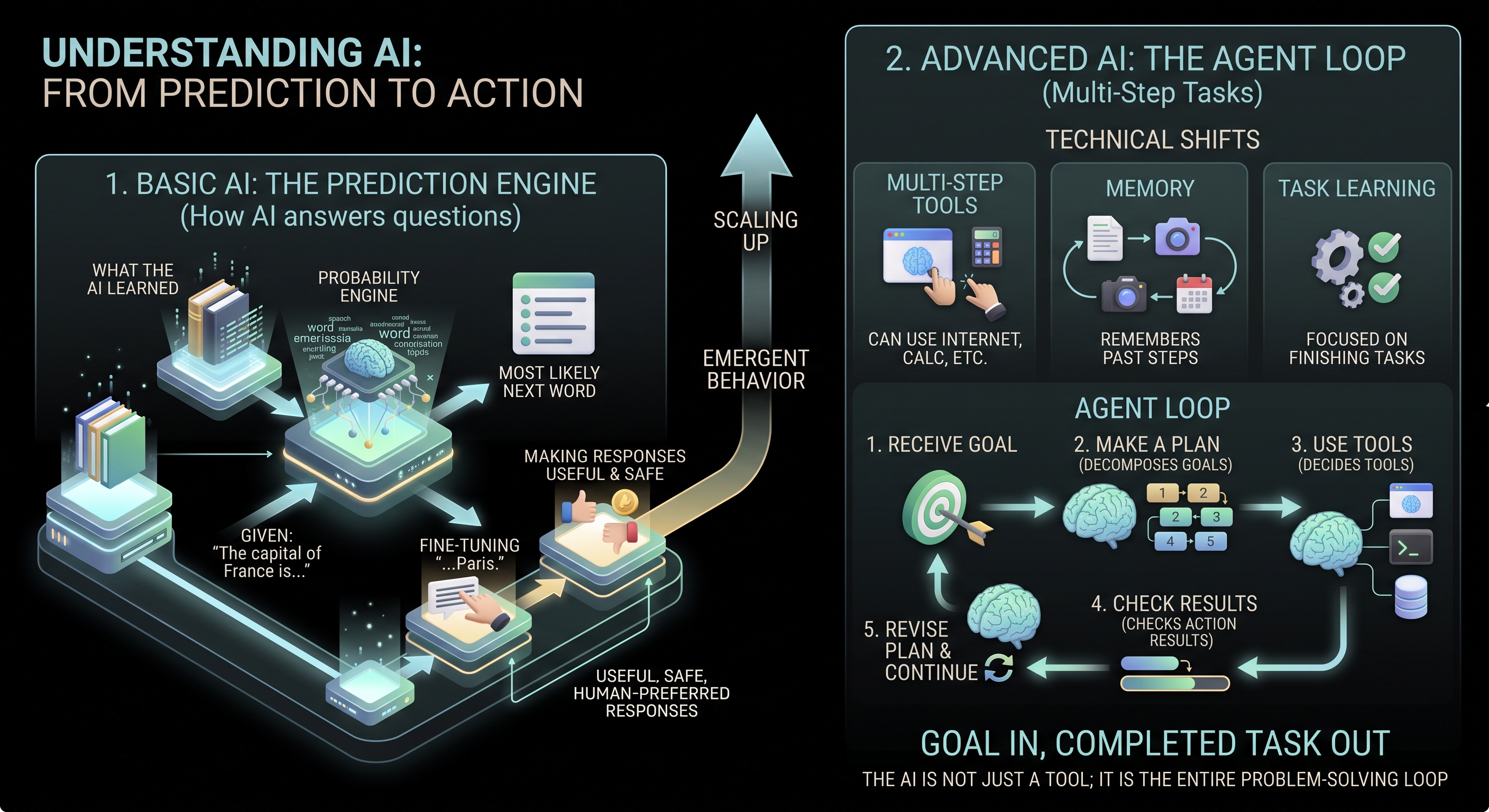
The distinction matters because it is where most public understanding of AI still lags the technology by roughly two years. A chatbot answers a question. An agent is given a goal, decomposes it into steps, executes those steps using tools — a browser, a terminal, a database, another piece of software — observes the result of each action, and revises its plan before the next one. The LLM is not a bystander in this loop; it is the loop. It functions simultaneously as the planner that breaks the goal into steps, the reasoner that decides which tool to call and with what arguments, and the evaluator that checks whether the last action actually worked before committing to the next. Multi-step tool use, long context windows that let an agent remember the last forty actions it took, and reinforcement learning tuned specifically for multi-turn task completion rather than single-turn answer quality are the three technical shifts that took LLMs from "text in, text out" to "goal in, completed task out."
40% Share
of enterprise applications projected by Gartner to embed task-specific AI agents by end-2026, up from low single digits two years prior
79% / 11% Share
of enterprises that report adopting AI agents, against the share that actually run them in production — the gap between pilot and deployment
USD 10.8B Projected
size of the agentic AI market in 2026, up from $7.6B in 2025
1,000,000 Token
context window on GPT-6 Astra built for sustained multi-step, tool-using tasks
Sources: CloudKeeper, Agentic AI Trends 2026; Svitla, Agentic AI Market Trends 2025–2026; Keyhole Software, Enterprise Agentic AI Market 2026; OpenAI, GPT-6 Astra system card (Sept 2026)
GPT-6 Astra is the clearest public data point for how far this has moved. Released by OpenAI on September 3, 2026, after the company deliberately slowed its rollout for additional cybersecurity safeguards, Astra was trained on more than 100,000 GPUs at OpenAI's Stargate site in Texas — by the company's own account, its largest training run to date. What is more revealing than the scale, though, is the shape of the benchmark gains it shipped with: a jump from 37.3% to 57.9% on Terminal-Bench 4.0, from 65.7% to 72.6% on OSWorld 2.0, and a near-perfect 97.6% on FrontierMath Tier 4. None of these is language-fluency tests. They measure whether a model can operate a computer, navigate a live desktop environment, and complete a long-running technical task without a human walking it through each step — which is precisely the capability profile agentic computing depends on. OpenAI president Greg Brockman called it a "generational leap," and the model became the first OpenAI has designated as reaching the "Critical" threshold in its cybersecurity preparedness framework — capable, under the right access, of finding and exploiting unknown vulnerabilities, previously requiring a person to guide each step.
Anthropic's Claude Fable sits on the other side of the same 2026 inflexion point, and the contrast is instructive. Fable 5 and its Mythos-tier sibling launched in June 2026 with additional safety layers specifically for biology, cybersecurity, and LLM research and development — categories chosen because they are exactly the domains where agentic capability shifts from productivity gains to structural risk. That caution was not merely marketing: OpenAI's own system card for Astra notes that in several of its most sensitive evaluation sets, Fable "refuses the majority of questions" rather than answering them. Access to both Fable and its Mythos counterpart was briefly suspended in mid-June 2026 to comply with U.S. Department of Commerce export controls and was restored only after those controls were lifted at the end of the month. Astra beat Fable 5 on Al Jazeera's reported benchmark comparison at launch — but the more consequential comparison is behavioural, not numerical: one lab shipped a model that finds exploits faster with fewer tokens; the other shipped a model that, on its own admission, declines to answer rather than risk it. Agentic computing does not remove that trade-off. It sharpens it, because an agent that refuses a step mid-task behaves very differently in production from a chatbot that refuses a question.
Why the enterprise gate and the open weight both count as strategy
The reason U.S. and Chinese frontier labs look so different in 2026 is not that one side is more capable — it is that they are optimising for different distribution problems, and agentic computing has made that divergence sharper rather than smaller.
| Dimension | United States (OpenAI, Anthropic, Google) | China (Alibaba, DeepSeek, Moonshot, Z.ai) |
|---|---|---|
| Release posture | Closed weights; staged, permissioned rollout | Open weights, mostly Apache 2.0 or MIT |
| Access model | Tiered API pricing; enterprise/gated cyber access | Free download; aggressive, sustained price cuts |
| Agentic gating | Capability-gated (e.g. Astra's Daybreak program for cyber-sensitive tasks) | Daybreak program for cyber-sensitive tasks)Capability shipped by default; governance largely left to the deployer |
| Primary lever | Safety evaluation, compliance, enterprise contracts | Distribution, developer mindshare, derivative ecosystem |
| Global South posture | Enterprise sales motion; limited direct diffusion | Active diffusion — training seats, cooperation centres, cheap compute-matched models |
Sources: Yotta Labs, GPT-6 Astra launch breakdown (Sept 2026); Datagravity, China's Open-Weight Takeover (Jun 2026); U.S.-China Economic and Security Review Commission, "Two Loops" (Mar 2026); Global Times, Qwen benchmark coverage (Aug 2026)
The American approach is, structurally, an enterprise-risk model: build the most capable system possible, then decide who is trustworthy enough to receive its most dangerous capabilities. Astra's own rollout illustrates the logic precisely — the general public gets a version that refuses proof-of-concept exploit requests, while vetted organisations under OpenAI's Daybreak program receive looser safeguards. That is a sensible posture for a lab whose largest revenue is enterprise and government contracts, where a single high-profile misuse incident is existential to the business relationship. It is a much less sensible posture if your strategic goal is global developer mindshare, which is precisely why it is not China's posture.
China's labs have made the opposite bet, and by mid-2026 it was paying off at a scale few predicted: Alibaba's Qwen has passed one billion cumulative Hugging Face downloads, overtaking Meta's Llama; Chinese open-weight models account for an estimated 61% of tokens consumed on OpenRouter; and roughly 40% of all new model derivatives built on Hugging Face are Qwen-based. This is not altruism — it is a distribution strategy that converts "open" into "default," the same move Android made against iOS. It carries a real structural advantage that is easy to miss if you only compare raw benchmark scores: Chinese labs are not subject to the U.S. Commerce Department's deemed-export rule, and cannot be ordered offline for users in a third country by an American regulatory letter. For a government evaluating dependency risk, that is not a minor technical footnote — it is the entire sovereignty question the source study on digital sovereignty and public AI infrastructure returns to again and again: control that has to be leased from a foreign jurisdiction is not control.
Agentic computing raises the stakes on both playbooks simultaneously. A closed, gated agent that takes real actions on real systems is easier to audit and hold accountable — but the accountability lives with a foreign company's compliance department. An open agentic model that anyone can fine-tune and deploy is easier to adapt to a local context and impossible for a foreign vendor to switch off — but the governance of what that agent is allowed to do becomes entirely the deploying country's own problem to solve, because nobody else is going to solve it for them.
Should Malaysia build its own foundation models? Yes — and the agentic layer is exactly why
Malaysia has already partially answered this question in practice rather than in policy papers. YTL AI Labs' ILMU, launched with the Prime Minister in attendance, ranks first in the world on the MalayMMLU benchmark — ahead of global frontier models — specifically because it was trained to handle "rojak" speech: the everyday blending of Bahasa Melayu, English, Mandarin and local dialects like Kelantanese within a single sentence, a pattern its developers say causes larger global models to drift mid-conversation into an unrelated third language. That is a fluency argument. The more urgent argument, in 2026, is an agentic one, and it is already underway: YTL AI Labs' Ilmu-Nemo-30B, developed with Nvidia, is explicitly described as an agentic model fine-tuned on Malaysian datasets, posting a 23% improvement on MalayMMLU, and the company has separately built ILMU Claw — a platform on the open-source OpenClaw framework specifically for organisations to build autonomous AI agents on local infrastructure.
My own view is that this is the correct call, and the reasoning holds even if you set national pride aside entirely. A chatbot that mishandles Bahasa Melayu produces an annoying answer. An agent that mishandles a Malaysian workflow — misreading a code-switched instruction from a district clerk, executing the wrong step in a government service process, or mismanaging a compliance action because it was optimised for a different regulatory context — produces a wrong action, taken autonomously, at the exact layer where accountability is hardest to reconstruct after the fact. As agentic computing moves from 40% of enterprise applications this year toward becoming the default interface for public services, the model making the decision matters more than the model answering the question, and Malaysia would be handing that decision layer to a foreign vendor's judgment calls by default if it did not build its own.
The counterargument deserves a fair hearing because it is not weak. Frontier training runs now cost hundreds of millions of dollars and consume compute at a scale — Astra alone trained on over 100,000 GPUs — that no mid-sized economy can match from a standing start, and a national model that never gets past a single flagship release risks becoming exactly the trap the sovereignty literature warns about: a domestic monopoly replacing a foreign one, with the same lack of downstream diffusion to smaller builders. That risk is real, and it is the reason the answer is not "build a GPT-6 competitor" — it is "build the layer no foreign lab has commercial reason to prioritise," which is precisely the Malay, Manglish and dialect fine-tuning ILMU has already demonstrated works, now extended into the agentic tooling built on top of it.
What should Malaysian builders and policymakers actually do next?
Move 01: Treat agentic fine-tuning as the priority, not the base model race. Malaysia cannot out-compute Stargate-scale training runs, and does not need to. ILMU-Nemo-30B shows the higher-leverage move is fine-tuning an efficient open or partner base model into an agent that correctly executes Malaysian-context workflows. Model: Ilmu-Nemo-30B on Nvidia Nemo; open Qwen/DeepSeek weights as a base layer.
Move 02: Fund the dialect and code-switching layer as agentic infrastructure, not a language nicety An agent that drifts into the wrong language mid-task is not a fluency bug — it is a task-completion failure. The corpus work that fixed this for ILMU's chat model needs the same budget line for its agent models. Model: ILMU's rojak-speech optimisation.
Move 03: Open the agent framework, not just the model ILMU Claw, built on the open-source OpenClaw framework, is the right instinct — it lets Malaysian developers build and audit their own agents on local infrastructure rather than renting a foreign agent platform. That openness should extend further down the stack, not just the top. Model: ILMU Claw on OpenClaw.
Move 04: Build public-sector procurement pathways specifically for agentic — not just conversational — deployments The fastest way to create referenceable, paying use cases for a domestic agent model is government workflows: district offices, healthcare intake, licensing. Public services are also where a foreign agent's local-context failures are most costly and least visible until it is too late. Model: BM-LLM's fine-tuning on government and public-service data.