
A drone spraying a plantation and an air taxi crossing a city skyline look like they come from different industries. They are not. Both are commercial activities conducted in the airspace below roughly 1,000 metres, and both depend on the same underlying stack: an aircraft that can fly itself or be flown remotely, an airspace management system that knows where every other aircraft is, and a regulator willing to say yes to routine, repeated, unsupervised flight. The low-altitude economy (LAE) is the term for the entire stack once it starts generating revenue rather than just headlines. The distance between "a drone that can fly a route" and "a drone network a hospital pays for every month" is the entire subject of this piece.
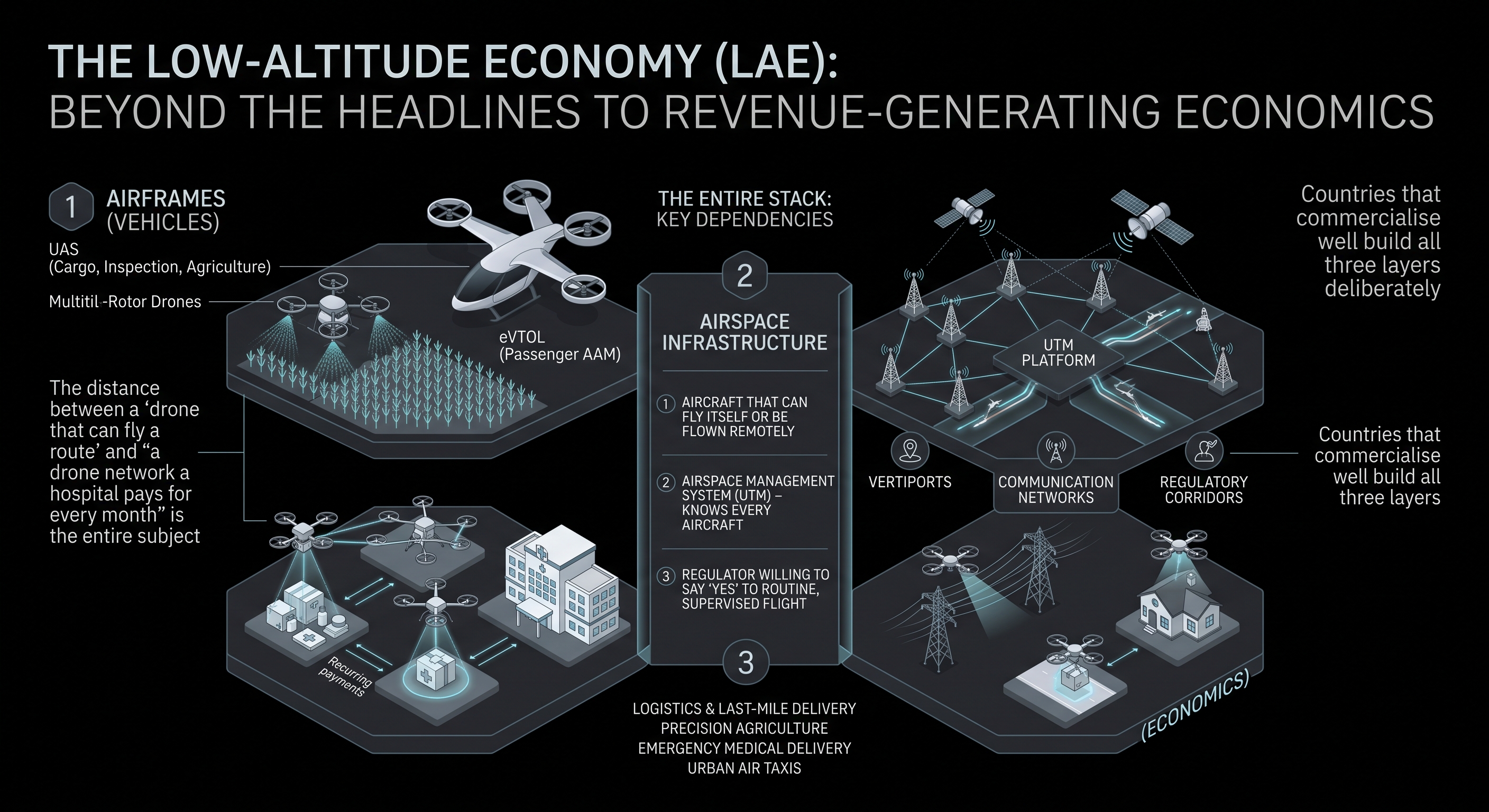
LAE activity is generally organised around three interlocking layers, and countries that commercialise it well tend to build all three deliberately rather than assuming aircraft alone will carry the economy. Airframes are the vehicles themselves — unmanned aerial systems (UAS) for cargo, inspection, and agriculture, and electric vertical take-off and landing aircraft (eVTOL) for passenger-carrying advanced air mobility (AAM). Airspace infrastructure is the invisible half of the system — UAS Traffic Management (UTM) platforms, vertiports, communication and navigation networks, and the regulatory corridors that let hundreds of aircraft share a sky that was never designed to be shared. Applications are where the economics actually show up — logistics and last-mile delivery, precision agriculture, infrastructure inspection, emergency medical delivery, aerial tourism, and eventually urban air taxis. A country can have world-class drones and still have no low-altitude economy, just as a country can have excellent AI papers and no AI industry.
The four building blocks of the low-altitude economy
Stripped down, LAE as an economic category rests on four components. Each one is being built by a different combination of manufacturers, regulators, and telecom operators, and progress in one does not guarantee progress in the others.
01: Aircraft Drones and UAS for cargo, inspection, and agriculture; eVTOLs and other AAM platforms for passenger transport — the hardware layer that has attracted the most investor attention and the most manufacturing capacity.
02: Airspace Management UTM systems that handle strategic deconfliction, real-time conflict detection, and dynamic corridor allocation — effectively air traffic control redesigned for thousands of small, autonomous aircraft instead of a few hundred large, piloted ones.
03: Ground Infrastructure Vertiports, charging and battery-swap stations, and the communications backbone — increasingly 5G/6G and satellite navigation — that keeps an aircraft in contact with its operator and the traffic management system at all times.
04: Applications The commercial use cases that actually generate revenue: logistics and delivery, precision agriculture, infrastructure inspection, medical supply chains, aerial tourism, and — furthest from mass commercialisation — urban air taxis.
How four regions are running this economy
No two governments are approaching LAE commercialisation the same way, and the differences map closely onto the AI commercialisation models each of these same countries runs — which is not a coincidence, since LAE is now one of the largest physical proving grounds for applied autonomy.
China — state-directed, already at scale China's low-altitude economy was elevated to a strategic emerging industrial cluster in the 15th Five-Year Plan (2026–2030), placed alongside quantum computing and AI as pillars of technological self-reliance. The Civil Aviation Administration of China (CAAC) projects the sector at roughly RMB 1.5 trillion in 2025, rising past RMB 3.5 trillion by 2035.
- Regulatory model: a flexible national airspace management framework introduced in 2023, paired with provincial pilot zones — Shenzhen and Guangzhou lead as national hubs — where operators can run beyond-visual-line-of-sight (BVLOS) trials with state backing before nationwide rollout.
- Operational scale: 3.28 million registered drones and 45.3 million cumulative flight hours in 2025, up nearly 70% year-on-year; Meituan alone had launched more than 50 drone delivery routes across major cities by the end of 2024.
- eVTOL posture: EHang's EH216-S became the first certified autonomous eVTOL, and manufacturing capacity is scaling fast — EHang's Yunfu facility alone targets 1,000 units a year, with additional plants in Hefei and Weihai.
- Governance trade-off: new national drone standards taking effect in May 2026 extend centralised tracking and control over the sector — a model of speed bought partly with surveillance architecture that other countries importing Chinese systems will inherit alongside the hardware.
United States — deregulation-led, certification-paced America's approach relies on private capital and a case-by-case certification process rather than a national industrial plan, with government acting mainly to clear regulatory friction and run structured pilot programmes.
- Regulatory model: the FAA's proposed Part 108 rule aims to normalise routine BVLOS drone operations, while eVTOL certification proceeds through a five-stage Type Certification process — Joby Aviation had reached Stage 4 by early 2026, with a Type Certificate still 12 to 18 months out even for the frontrunner.
- De-risking mechanism: an eVTOL Integration Pilot Program (eIPP), directed by a June 2025 executive order, selected eight state and local projects — spanning air-taxi service in New York, regional routes across Texas, and cargo and medical logistics in Utah and North Carolina — with operations targeted to begin by summer 2026.
- Capital strategy: Archer Aviation is generating near-term revenue by selling aircraft to local operating partners in the Middle East rather than retaining operational control, while Amazon Prime Air has logged over 6,300 certification flights with its MK30 drones.
- Constraint: international harmonisation lags — an operator built for one state's rules cannot easily cross into another's, let alone another country's.
Germany & the EU — safety-first, coordination-heavy The EU's U-space initiative and EASA's regulatory framework aim to make low-altitude airspace as safe as traditional aviation before scaling commercial operations, which has produced a technically rigorous but slower-moving system.
- Regulatory model: EASA's Certification Specifications extend existing Part 27 aviation compliance to eVTOLs, and validation is widely described as more stringent than the FAA's — commercial operations are projected for 2026–2027, roughly two years behind the US.
- Institutional move: EASA opened its first regulatory proposal on Artificial Intelligence for Aviation for consultation in November 2025, an early attempt to formalise how AI-based autonomy gets certified rather than treating it as an afterthought.
- Industrial consolidation: Diamond Aircraft's acquisition of Volocopter in November 2025 pairs Volocopter's more than 2,000 test flights and dual EASA/FAA certification experience with Diamond's existing manufacturing base in Austria and Canada.
- UK divergence: post-Brexit, the UK CAA has run its own path — a Class Marking framework for open-category drones took effect from January 2026, retaining EU-derived standards while setting its own compliance timeline.
Singapore & the UAE — small-state, first-mover regulation Land-scarce, airspace-constrained states cannot out-build larger economies on volume, so both have competed instead by writing usable rules early and building talent pipelines to match.
- Regulatory model: Singapore's Unmanned Aircraft Regulations were among the first comprehensive national drone frameworks globally, and the Civil Aviation Authority of Singapore (CAAS) helped the Asia-Pacific region adopt shared reference materials for regulating air taxis and drones in mid-2025.
- Constraint acknowledged openly: Singapore's own transport ministry has flagged limited airspace shared with military use and a dense, high-rise urban environment as structural limits no amount of regulation removes.
- Talent pipeline: four of Singapore's five polytechnics are approved Unmanned Aircraft Training Organisations, drone modules are entering secondary school curricula, and SkillsFuture credits subsidise short-course drone training for the public.
- Dubai's parallel bet: the UAE has positioned itself explicitly as a manufacturing and innovation hub for unmanned aircraft, treating LAE as an export industry rather than only a domestic transport upgrade.
The R&D roles that actually carry LAE forward
LAE looks like an aviation story, but the work that determines whether it scales is R&D work, and it splits along the same three tracks that carry any deep-tech sector from lab to market. Basic research — aerodynamics for distributed electric propulsion, battery energy density and thermal management, and the control theory behind autonomous flight — occurs mostly at universities and aerospace research institutes and rarely reaches customers directly. Applied research takes those foundations and points them at the specific problems LAE cannot avoid: computer vision and sensor fusion for detect-and-avoid, multi-agent reinforcement learning for swarm coordination, and the algorithms that let a UTM system replan thousands of flight paths in real time as conditions change. Applied engineering is where this becomes infrastructure that withstands daily operations — vertiport ground systems, cybersecurity for aircraft-to-ground communication links, and the verification and validation pipelines that enable a safety regulator to certify an AI-based flight control system rather than take a manufacturer's word for it.
RM184 billion
The infrastructure Malaysia already has, unconnected to LAE
240 companies
Racing to certify eVTOLs — and 12 to 18 months minimum to get there
3.28 million
Registered drones, 45.3 million flight hours
US$55 billion
Global UAV market by 2030
This is also where LAE and AI commercialisation converge into the same problem. A UTM platform performing real-time demand-capacity balancing across a dense urban corridor is, functionally, an applied AI system running in a safety-critical environment — the same six-stage journey from research to pilot to validation to partnership to investment to market entry applies, except the "partnership" stage here usually means a civil aviation authority rather than a corporate buyer, and the "validation" stage means proving an aircraft or algorithm safe under regulatory scrutiny rather than proving a model accurate under a benchmark. Countries that treat LAE purely as a hardware manufacturing opportunity, and underfund the applied-research layer that produces autonomy and airspace-management software, tend to end up assembling or importing someone else's aircraft rather than exporting their own systems.
Where Malaysia stands
Malaysia is not starting from a blank sheet. Drone operations already fall under the Civil Aviation Authority of Malaysia (CAAM)'s existing aviation rules, and the Drone Technology Action Plan 2022–2030 (MDTAP30), led by MRANTI under MOSTI, has been building domestic drone capability, talent, and commercialisation pathways since 2022. What changed in 2026 is the shift from drone policy to a full low-altitude economy policy: CAAM hosted the inaugural LAE Forum in June 2026, and Transport Minister Anthony Loke announced that a comprehensive LAE blueprint — covering drones, UAS, advanced air mobility, aerial logistics, infrastructure inspection, agriculture, and emergency services — would be introduced by year-end, developed alongside a public consultation on the Malaysia Low Altitude Economy Framework.
The country's existing applications are already commercially real rather than hypothetical. Medical drone delivery pilots are operating in Sabah and Pahang, cutting delivery times for rural healthcare logistics from hours to minutes. Precision agriculture — spraying and crop monitoring — is established across plantations. Aonic (formerly Poladrone) reportedly exceeds RM100 million in revenue and has become profitable, while Meraque's RACE platform is being positioned as one of Malaysia's first autonomous ground vehicles for plantations. CAAM has partnered with Futurise to publish an Advanced Air Mobility Concept of Operations, and a UAS Traffic Management System (UAS-TMS) overhaul is underway, moving the country from a manual, email-based flight approval process toward digital, Remote-ID-style registration. At MyDrone Expo 2026, Prime Minister Anwar Ibrahim directed ministries, agencies, research bodies, and universities to give the sector full regulatory and ecosystem support, citing a global UAV market projected to exceed US$55 billion by 2030.
CAAM's own leadership frames the opportunity plainly: the Asia-Pacific region accounts for more than 30% of global aviation activity, roughly 240 companies worldwide are racing to certify eVTOL aircraft, and Malaysia already holds several of the underlying capabilities — an established aerospace manufacturing base, a globally competitive semiconductor sector, and RM184 billion in secured data centre and cloud infrastructure investment that could underpin the digital backbone autonomous aviation requires.
The future of LAE is an AI story
Every constraint currently slowing LAE globally — airspace congestion, certification cost, the labour intensity of drone operations — points toward the same solution: more autonomy, running on more capable AI, certified to a higher standard than consumer AI has ever needed to meet.
The clearest shift is in airspace management itself. Static, pre-planned flight routing cannot handle the density LAE operators are targeting; research groups building next-generation UTM systems are combining machine learning with metaheuristic optimisation to perform real-time demand-capacity balancing, replanning thousands of flight paths as conditions change rather than relying on fixed corridors. This is the aviation world analogue of the shift from rules-based software to learned systems that reshaped every other industry AI touched — except here, the failure mode is a mid-air collision rather than a bad recommendation, which is why regulators are moving cautiously.
The second shift is embodied autonomy on the aircraft itself. Rather than following pre-programmed paths, researchers are exploring embodied AI — agents that perceive their environment, plan actions, and adapt to obstacles and weather in real time, extending the same perception-planning-action loop from robotics into flight control, obstacle avoidance, and swarm coordination. Combined with edge computing that keeps time-critical decisions on board while offloading heavier computation — environmental modelling, multi-agent learning — to mobile-edge and cloud infrastructure, this points toward drone and eVTOL fleets that behave less like remote-controlled vehicles and more like autonomous agents operating under human-set constraints.
The third shift, and the one regulators are only beginning to formalise, is AI in the safety case itself. EASA's first regulatory proposal specifically addressing artificial intelligence in aviation, opened for consultation in November 2025, signals that the certification question is no longer just "can this aircraft fly safely" but "can this AI-based flight-control or traffic-management system be verified, validated, and trusted the way a human pilot or air traffic controller currently is." That question will shape which countries can scale BVLOS and autonomous eVTOL operations fastest — not the countries with the most advanced models, but the ones that build a certification pathway capable of evaluating them.
For Malaysia, the implication is direct: LAE is not simply an aviation and logistics opportunity sitting next to the AI Nation 2030 agenda — it is one of the most concrete near-term commercial applications that agenda has. A country that has already committed to AI commercialisation infrastructure, sovereign compute, and applied AI talent development has a natural on-ramp to building the autonomy, sensing, and airspace-management software that LAE will run on, rather than only regulating and importing the aircraft produced by other countries' R&D.
A feasible model: Corridor-and-Scale
Malaysia does not need China's provincial pilot-zone apparatus or the EU's full compliance architecture. It needs a model sized to what it already has — an aviation regulator with a live mandate, an applied AI policy push already underway, and specific rural and plantation use cases already proving value — rather than a system built for economies with larger domestic aircraft manufacturing industries. The following four-layer model, Corridor-and-Scale, is calibrated to that starting position.
Layer 1 — Single Regulatory Authority: CAAM, now expanded with the economic and consumer-protection functions transferred from MAVCOM, plays the role Korea's National AI Committee plays for AI: one body with real authority to issue the LAE blueprint, arbitrate between MOSTI, the Ministry of Transport, and state governments, and avoid the over-regulation Minister Loke has publicly flagged as a risk to the sector's growth.
Layer 2 — Sandbox-to-Certification Pipeline: The CAAM–Futurise partnership on the Advanced Air Mobility Concept of Operations, paired with the UAS-TMS digital registration overhaul, should function as a formal, stage-gated pathway — sandbox trial, BVLOS validation, commercial certification — with published graduation criteria, so an operator testing a medical drone route in Sabah has a known, time-bound path to nationwide commercial approval instead of a fresh application at every stage.
Layer 3 — Demand Anchoring in Proven Sectors: Malaysia's own early wins — medical delivery in Sabah and Pahang, precision agriculture across plantations, port and rail infrastructure inspection — are exactly the kind of state-anchored, GLC-adjacent first customer that de-risked LAE in every region reviewed above. Formalising these as designated national demonstration corridors, rather than leaving them as separate pilots, converts proof points into a repeatable commercialisation template.
Layer 4 — Talent and Systems R&D: Malaysia's aerospace and semiconductor base gives it a genuine advantage in propulsion, sensing, and avionics hardware; what is missing is a funded pipeline for the applied-research layer — autonomy algorithms, UTM software, AI-based airspace management — that determines whether the country builds LAE systems or only assembles and operates aircraft designed elsewhere. Anchoring this in universities and MRANTI's existing AI Sandbox, rather than treating it as a separate initiative, keeps LAE R&D connected to the country's broader AI commercialisation push, rather than running as a parallel track.
Key action items
Key Item 1: Publish the LAE blueprint with graduation criteria, not just principles. The year-end blueprint Minister Loke has committed to should specify the concrete milestones — technical, safety, and commercial — that move an operator from sandbox trial to BVLOS validation to commercial licence, so operators can plan against a known pipeline rather than a maze of case-by-case approvals.
Key Item 2: Designate Sabah, Pahang, and the plantation sector as formal national demonstration corridors. Converting existing medical-delivery and precision-agriculture pilots into designated corridors with dedicated airspace, standing regulatory approval, and public performance data gives Malaysia the same de-risking mechanism that China's pilot zones and the US's eIPP sites are built to provide.
Key Item 3: Fund UTM and autonomy software as a distinct R&D line, not an aircraft-manufacturing afterthought. Malaysia's semiconductor and aerospace strengths focus on hardware; airspace-management algorithms, sensor fusion, and swarm-coordination software need their own funded research agenda within MRANTI's AI Sandbox and university partnerships, or the country will end up hosting aircraft rather than exporting the systems that fly them.
Key Item 4: Convert data centre and telecom investment into LAE-specific digital infrastructure. Attach conditions to major data-centre and 5G/6G rollout approvals that reserve compute and connectivity capacity for UTM platforms and autonomous-flight research, so the RM184 billion infrastructure pipeline builds a genuine airspace-management backbone rather than only serving unrelated hyperscale workloads.
Key Item 5: Build a dedicated LAE talent pipeline, not a generalist aviation or software one. Following Singapore's model of embedding drone and AAM modules directly into polytechnic and university curricula, Malaysia should certify Unmanned Aircraft Training Organisations at scale and tie funding to the production of pilots, UTM engineers, and certification specialists specifically, rather than assuming that existing aerospace or computer science graduates will migrate into the sector.
Key Item 6: Coordinate state and federal roles before overlapping platforms emerge. Sabah's push for a state-level drone coordination platform illustrates a real risk — state initiatives duplicating rather than complementing CAAM's federal aviation mandate. A published division of responsibility between CAAM and state agencies should accompany the blueprint, not follow it.
Key Item 7: Build the certification pathway for AI-based flight and traffic systems now, not after adoption scales. Following EASA's early move to open AI-for-aviation certification for consultation, Malaysia should begin defining how an AI-based UTM or autonomous flight-control system gets verified and certified well before autonomous BVLOS operations move from pilot to routine commercial use.
What this means for builders and decision-makers
For founders and researchers, the practical takeaway is that Malaysia's LAE-relevant infrastructure — an aviation regulator actively rewriting its own rules, a functioning drone commercialisation track record in Aonic and Meraque, and real rural demand in healthcare and agriculture — is more developed than a "new industry" framing suggests; the open question is whether the coming blueprint gives that infrastructure a clear, time-bound path from sandbox to national scale. For GLCs and state governments, the opportunity mirrors what China, the US, and Singapore all treat as the pivot point: becoming the first anchor customer for a Malaysian drone or eVTOL operator, in a hospital network, a plantation group, or a port authority, is what turns a pilot into a business. For policymakers, the lesson carried over directly from AI commercialisation is that a blueprint without a formal certification and funding pipeline behind it produces more demonstration flights, not more companies. Malaysia has working pilots in the exact sectors — rural health, agriculture, infrastructure inspection — that other countries are still trying to manufacture as proof points. What happens next is whether those pilots get formalised into a system, or left as good projects solving the same problem in parallel.