
For a decade, "AI" mostly meant software: chatbots, recommendation engines, code assistants. IEEE, McKinsey and Gartner now describe something different. AI is leaving the screen, and it needs a great deal of electricity to do so. This post sets out what the three sources say, how leading countries compare, and where Malaysia should place its bets.
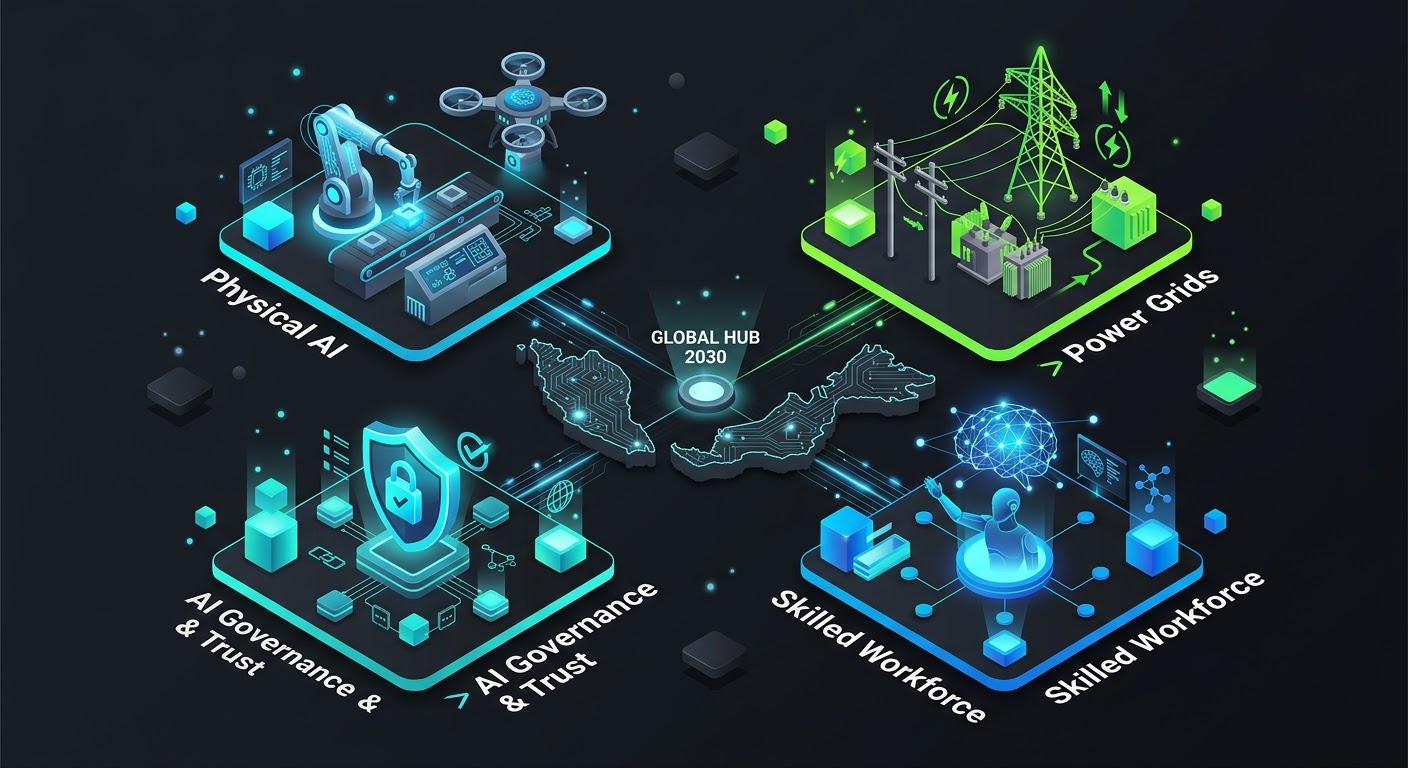
The megatrend: AI, energy and the physical world converge
The three forecasters describe the same shift from different angles.
- IEEE Future Directions. The Technology Megatrends 2030 report draws on 168 experts across 38 countries and assesses 30 technologies in five areas: AI, energy, health and biotech, space, and physical AI (robotics). Its core message is that the coming decade will be shaped less by isolated breakthroughs than by interdependencies among AI, energy and physical systems. How AI Will Reshape Life by 2030: New IEEE Megatrends Report Unveils Tech Forces Transforming Homes, Schools, and Work | STM Publishing News +2
- McKinsey. Its Technology Trends Outlook 2026 says the technology story has moved off the screen into the physical world: power grids, chips, robots and satellites. Energy technologies drew nearly USD 200 billion in 2025, and AI infrastructure spending doubled in a year. The key question is who can build the hardware and assemble the skilled workforce. Technology Trends Outlook 2026 - New McKinsey Report - fintechnews.org +2
- Gartner. Its predictions, published this week, include that by 2030, 80% of front-line workers at international companies will be assisted by physical AI. They also say that USD 10 trillion of enterprise-owned energy will turn Global 2000 firms into unexpected power providers. gartner
I'd call the megatrend physical, energy-bound AI: intelligence that acts in the real world and is limited by the power, hardware and trust behind it.
Four key points
1. Physical AI goes mainstream Intelligence moves from screens into machines. IEEE's panel sees physical AI and robotics among the areas with the greatest potential for major advances over the next four years, and Gartner's 80% figure points the same way. Robotics & Automation News
2. Power is the new bottleneck Whoever has the grid can scale AI. IEEE says AI scalability, compute infrastructure and energy grids are now tightly linked as a first-order problem. Meanwhile, global AI compute has grown more than threefold every year since 2022. IEEE Spectrum
3. Trust decides what scales Safe and explainable beats fast. IEEE's panel says the technologies most likely to scale across society are built on trust, explainability and safe human-AI interaction. Gartner predicts that insurers, not regulators, will drive AI governance by 2030. gartner
4. People are the real infrastructure Continuous learning replaces one-off degrees. IEEE expects AI literacy to become a basic work skill across office, trade and technical roles. Stanford's AI Index reports that employment for software developers aged 22 to 25 has fallen by nearly a fifth. AccessStanford
How leading countries compare
Three patterns stand out. The US and UAE lead on capital, and China leads on physical scale. Singapore and South Korea lead on coordination, backed by real budgets and, in Korea's case, a real law. Money alone doesn't buy adoption: the US outspends China 23 to 1 on private AI investment, yet the performance gap between their best models has shrunk to 2.7%. The US also sits at 24th in adoption, well below Singapore and the UAE.
| Country | Where it leads | Infrastructure and policy moves | Watch-out |
|---|---|---|---|
| United States | USD 285.9 billion in private AI investment in 2025; 50 notable models | 1st in Oxford Insights' 2025 readiness index, on the strength of its private sector, research base and compute | Ranks only 24th in AI adoption (28.3%); AI talent moving to the US is down 89% since 2017 |
| China | 295,000 industrial robots installed in 2024, against 34,200 in the US; 69.7% of AI patent grants | Building a sovereign chip and AI stack; readiness rank up from 23rd to 8th | Opaque data means its rank likely understates its real capability, so it is hard to benchmark |
| Singapore | 61% AI adoption; a PM-chaired National AI Council since February 2026 | SGD 37 billion under RIE2030, a 400% tax deduction on qualifying AI spending, and four national AI Missions | Small land and power base; its capacity constraints pushed data centre demand south to Malaysia |
| South Korea | 1st globally in AI patents per capita; a comprehensive AI Basic Act in force since 22 Jan 2026 | A 260,000-GPU national ecosystem and five domestic foundation-model consortia | Still depends on US chips and software |
| UAE | 64% AI adoption | Stargate UAE's first 200 MW phase is due in 2026 within a 5 GW campus target | Chip access hinges on US export approvals |
| Malaysia | Data centre capacity grew from about 10 MW (2021) to about 1.3 GW (2024) | A MYR 2 billion sovereign AI cloud inside a MYR 5.9B AI package; a semiconductor strategy with at least USD 5.3 billion in support | Grid approvals can take up to 18 months, and data centres use about 40% of declared demand |
Malaysia is a credible contender, not yet a leader. In Oxford Insights' 2024 edition, it scored 71.4, behind Singapore (84.3) and South Korea (80.0). Its own plan, AI Nation 2030, aims for a top-10 global AI ranking, up to 1.2 percentage points of extra GDP growth and 300,000 AI-related jobs by 2030. The same plan admits gaps in advanced talent depth, private investment and research-to-commercialisation.
What Malaysia should focus on
Malaysia will not out-build the US or China on frontier models, and it doesn't need to. The megatrend rewards countries that combine power, physical industry and trust, and Malaysia already has pieces of each. My suggested directions:
- Make power the national AI advantage. Grid delays, not generation, are the bottleneck. Malaysia plans 6 to 8 GW of new gas and up to 10 GW of renewables by 2030, and is looking to Sarawak power and the ASEAN Power Grid. Tie incentives to utilisation, efficiency and clean-energy targets, as the AI Nation plan itself proposes with penalty clauses for data centres that miss PUE or renewable targets. techwireasia
- Point physical AI at industries Malaysia already runs. Semiconductor back-end, manufacturing and plantations are natural testbeds. Manufacturing is about 24% of GDP, and the plantation platform targets up to a 70% cut in manual labour. That is Gartner's front-line-worker scenario, applied locally. okie
- Turn hosted compute into local capability. Racks in Johor are not an AI industry until Malaysian firms use and build on them. Compute vouchers for SMEs and researchers, plus Bahasa Melayu and local-context models, would help. The MYR 2 billion sovereign cloud is small next to inbound foreign investment, so use it as shared capacity rather than a rival to the hyperscalers. techwireasia
- Build talent and trust together. The semiconductor strategy targets 60,000 engineers, and Arm plans to train 10,000. Pair that with AI-fluent technicians and operators, and replace voluntary guidelines with risk-based rules and an AI trust function. Investors and insurers will increasingly look for that. TechCrunch
These directions are my own synthesis of the evidence, not recommendations from IEEE, McKinsey or Gartner.
References:
- IEEE Future Directions: Technology Megatrends
- IEEE Megatrends 2030 report page
- IEEE Report Reveals How AI Will Reshape Life by 2030 (NJ Business Magazine)
- IEEE releases Technology Megatrends 2030 Report (Access)
- Interview with IEEE's Dejan Milojicic (Robotics & Automation News)
- McKinsey Technology Trends Outlook 2026 (via Fintech News)
- Gartner Unveils Top Strategic Predictions for 2027 and Beyond
- The 2026 AI Index Report (Stanford HAI) and its Economy chapter
- Stanford's AI Index for 2026 Shows the State of AI (IEEE Spectrum)
- Government AI Readiness Index 2025 (Oxford Insights)
- Singapore: the most AI-ready East Asian nation (Katadata, 2024 index scores)
- Singapore AI Trends in 2026 (Second Talent) and Singapore's National AI Strategy update (MDDI)
- South Korea's AI Basic Act (Cooley)
- South Korea Becomes First G20 Nation to Give All Citizens Free AI Access (Tech Times)
- South Korea's free AI runs on American chips it cannot replace (Indoneo)
- Stargate UAE's first phase to be completed in Q3 2026 (The National)
- UAE AI data centre investment overview (Data Center World Middle East)
- Malaysia's data centre policy is saying the quiet part out loud (Tech Wire Asia)
- National AI Action Plan 2026-2030 (AI Nation 2030), Ministry of Digital Malaysia
- Arm to sign $250M chip deal with Malaysia (TechCrunch)