
Agriculture is often described as humanity's oldest industry, but it is being rebuilt in real time. What used to be a linear chain—seed, soil, sun, harvest, market—is becoming a networked ecosystem of sensors, satellites, drones, biologists, and data platforms, all wrapped around a supply chain that still obeys the same biological clock it always has. That last part is what makes smart agriculture different from smart manufacturing or smart logistics: you cannot compress a plant's growth cycle with more compute. Innovation has to work with biology, not around it.
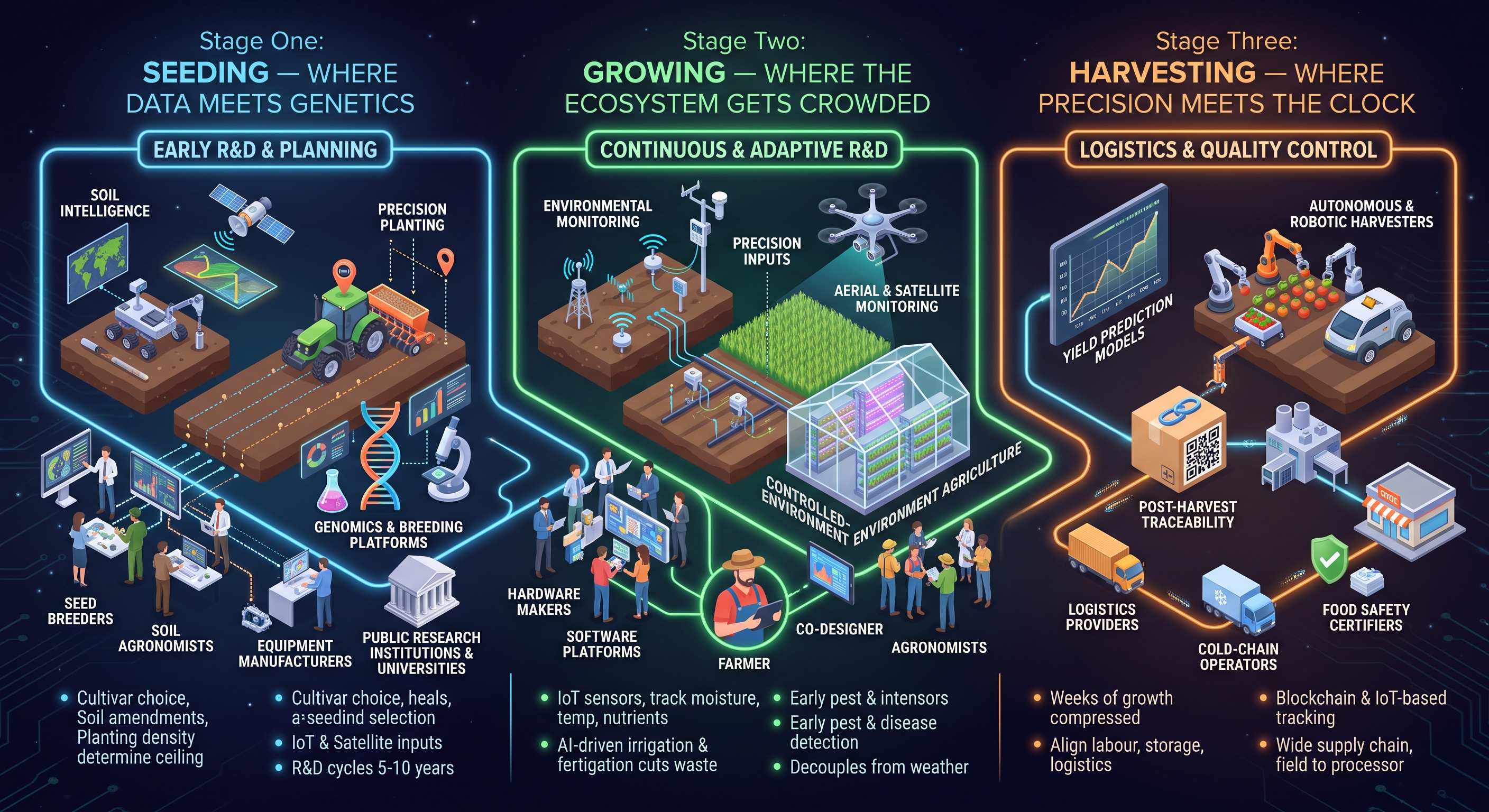
This is why the most successful agri-tech ecosystems in the world aren't the ones with the flashiest single piece of technology. They're the ones that have organised collaboration and R&D around each distinct stage of the supply chain — seeding, growing, and harvesting — because each stage has entirely different constraints, timelines, and stakeholders.
Stage One: Seeding — Where Data Meets Genetics
The seeding stage is where agriculture is closest to being a science, and where R&D has the longest lead time. Decisions made here — which cultivar, which soil amendment, which planting density — determine the ceiling for everything downstream. Smart seeding today typically combines:
- Soil intelligence: IoT soil sensors and satellite-derived soil maps feeding into planting decisions before a single seed goes in the ground.
- Precision planting: GPS-guided seeders and variable-rate technology that adjust seed spacing and depth to micro-variations in a field, rather than treating a whole plot as uniform.
- Genomics and breeding platforms: AI-assisted crop breeding that shortens the time it takes to develop varieties suited to local climate stress, pests, or nutrient profiles.
Collaboration here is unavoidable because no single company owns the whole stack. Seed breeders, agronomists, soil scientists, and equipment manufacturers must work from the same data before planting even starts. This stage is also most tied to public research institutions and universities, because the R&D cycle for a new crop variety can run five to ten years —far longer than any single company's product roadmap.
Stage Two: Growing — Where the Ecosystem Gets Crowded
Growing is the longest and most technologically dense stage, and it's where most of the "smart agriculture" headlines live. It's also the stage most exposed to the plant's biology and external shocks—weather, pests, disease—so R&D here must be continuous and adaptive rather than front-loaded.
Typical layers of the growing-stage ecosystem:
- Environmental monitoring: IoT sensors tracking soil moisture, temperature, humidity, and nutrient levels in real time.
- Precision inputs: AI-driven irrigation and fertigation systems that apply water and nutrients only where and when the crop needs them, cutting waste rather than yield.
- Aerial and satellite monitoring: drones and satellite imagery (multispectral, NDVI) used for early pest and disease detection, often days or weeks before visible symptoms appear.
- Controlled-environment agriculture: smart greenhouses and vertical farms that decouple growing conditions from outdoor weather entirely.
This is the stage where collaboration among hardware makers, software platforms, agronomists, and farmers becomes an almost daily loop rather than a one-time handoff. A sensor is useless without an agronomic model to interpret it, and a model is useless without a farmer who trusts it and acts on its output. The best ecosystems treat the farmer as a co-designer of the technology, not just an end user.
Stage Three: Harvesting — Where Precision Meets the Clock
Harvesting compresses weeks of biological growth into a narrow window where quality, timing, and labour must align. Smart harvesting technology includes:
- Yield prediction models that use growing-season data to forecast harvest timing and volume, helping align labour, storage, and logistics in advance.
- Autonomous and robotic harvesters for labor-constrained crops, especially fruits and vegetables that are hard to mechanize with traditional equipment.
- Post-harvest traceability: blockchain and IoT-based tracking that follows produce from field to processor to retailer, increasingly demanded by both regulators and export markets.
Harvesting is also where the supply chain ecosystem widens to include logistics providers, cold-chain operators, and food safety certifiers—actors who weren't part of the conversation at the seeding stage but now determine whether upstream precision actually turns into revenue. A perfectly grown crop that rots in a truck because of a broken cold chain is still a failed harvest.
Why R&D Has to Follow the Supply Chain, Not Lead It
In most tech sectors, R&D happens upstream, and the supply chain absorbs whatever comes out of the lab. A chip is designed, then manufactured, then shipped — the product doesn't change once it leaves the lab. Agriculture inverts this relationship entirely. Because the "product" is a living organism responding to soil, weather, pests, and time in ways no lab can fully predict, research has to stay embedded at every stage of the supply chain rather than being front-loaded and then handed off.
Seeding-stage R&D is slow, genetic, and institutional. Breeding a new crop variety — one resistant to a specific pest, tolerant of drought, or suited to a particular soil chemistry — can take five to ten years from lab to field. This kind of R&D can't be rushed by better software or more funding alone; it's bound by the plant's own reproductive and growth cycles. It's also why this stage leans so heavily on public universities and government research institutions rather than fast-moving startups: the payback horizon is simply too long for most private capital to underwrite alone.
Growing-stage R&D is fast, iterative, and sensor-driven. Once a crop is in the ground, the R&D rhythm changes completely. This is where agriculture starts to resemble software development — sensors generate a constant stream of data on moisture, temperature, and plant health, and models need retraining and irrigation or fertigation schedules adjusted within days, or even hours, not years. A pest outbreak or unexpected heatwave can require a real-time response, so the ecosystem needs tight feedback loops between the field, the data platform, and the agronomist—much closer to a product team shipping updates than a lab running a multi-year trial.
Harvesting-stage R&D is operational, focused on timing, labour, and loss reduction. By the time a crop is ready to harvest, the biological risk is mostly behind it, but a new set of constraints takes over: a narrow harvest window, labour availability, and the risk of loss between the field and the market. R&D here looks less like biology and more like logistics and robotics — yield-prediction models to plan labour and storage in advance, autonomous harvesters to fill labour gaps, and traceability systems that follow produce downstream to processors and retailers.
This staged structure means no single breakthrough—a superior seed variety, a brilliant irrigation algorithm, a highly efficient harvesting robot—can carry an entire ecosystem on its own. A country with excellent seed genetics but no growing-stage monitoring still loses yield to undetected pest pressure. A country with sophisticated drone-based crop monitoring but no post-harvest traceability still bleeds value once produce leaves the farm. This is precisely why the countries examined below don't compete on having the single best piece of agri-tech; they compete on how well they've built connective tissue — shared data, shared institutions, shared incentives — that lets R&D travel with the crop from seed to shelf, rather than stopping at whichever stage happens to attract the most funding or attention.
Country Snapshots: Three Different Playbooks
South Korea: State-Directed Technology Transformation
South Korea treats smart agriculture as a national industrial policy, not just a farming upgrade. Its Agriculture and Rural AI Transformation (AX) strategy, jointly run by the Ministry of Agriculture and the Ministry of Science and ICT, is explicitly framed around an ageing farm population and shrinking rural labour — smart farming is positioned as a survival strategy, not an optimisation. The government has set concrete, trackable targets: growing smart-farming enterprises from around two dozen to 100 within a few years, and pushing smart greenhouse coverage from roughly 14% of total greenhouse area toward 30% by 2027, alongside an export target for smart-farm products.
What's distinctive is that Korea has turned a domestic constraint into an export product, the same playbook it used with shipbuilding and construction. It builds demonstration smart farms — shipping-container growing units — in target markets like Kazakhstan, Vietnam, Australia, and now Saudi Arabia, using them to seed demand for Korean agri-tech abroad. Domestically, shared machinery centres and AI-based livestock grading tools are being rolled out specifically so smaller and mid-sized farms, not just large agribusiness, can access the technology.
The Netherlands: Precision as a Land-Scarcity Strategy
The Netherlands runs the opposite playbook: instead of state-directed export policy, it has built an integrated cluster of research institutions (Wageningen University as the anchor), private agri-tech firms, and farmer cooperatives, all oriented around the same constraint—almost no spare land. Precision farming isn't an add-on; it's the default. Drones and satellite imagery routinely feed nitrogen and disease models for greenhouse and open-field crops, and closed-loop nutrient and water recycling is standard practice rather than a sustainability initiative layered on top.
The ecosystem's strength is its density: growers, greenhouse engineers, and researchers are geographically clustered (the Westland region is the clearest example), which shortens the feedback loop between a sensor reading and an agronomic decision. It's a model built on collaboration by proximity rather than collaboration by government mandate.
Japan: Robotics as the Answer to a Vanishing Workforce
Japan's ecosystem is built around a single, unavoidable constraint: a shrinking, ageing farming population with almost no arable land left to expand into. Rather than growing more land, Japan has focused R&D on replacing labour and compressing growing space. Autonomous tractors, drones, and vision-guided robotic harvesters — increasingly bundled into government-backed "smart agriculture zones" that combine robotics, drones, and sensor networks in one deployment — are treated as a workforce substitute, not just an efficiency upgrade.
The other defining feature is Japan's lead in controlled-environment agriculture: hydroponic vertical farms and plant-factory systems, supported by the Japan Plant Factory Association, are scaling fast, with hydroponics expected to account for the majority of the controlled-environment market by growing method. Corporate and startup collaboration is dense here too — SoftBank's Innovation Fund backs agri-tech startups working on sensor networks and farm robotics specifically to get affordable tools to mid-size farms faster, while indoor-farming operators lean on Japan's existing manufacturing and robotics expertise rather than building automation capability from scratch. Traceability is the other constant thread: strict domestic and export-quality expectations, especially for premium fruit and rice, have pushed blockchain- and QR-based traceability into the mainstream well ahead of most other markets.
At a Glance: Three Ecosystem Models
| South Korea | Netherlands | Japan | |
|---|---|---|---|
| Core driver | Ageing farm population, rural labor decline | Extreme land scarcity | Ageing, shrinking rural workforce |
| Ecosystem model | State-directed industrial policy | Dense regional cluster (research + private + farmer) | Government-backed zones + corporate/startup partnership |
| Strongest supply-chain stage | Growing (smart greenhouses, shared machinery) | Growing (precision inputs, closed-loop resource use) | Growing & harvesting (robotics, autonomous harvesting) |
| Signature technology | Smart greenhouses, AI livestock grading | Precision irrigation, closed-loop nutrient recycling | Autonomous harvesters, hydroponic plant factories |
| Key institution/anchor | Ministry of Agriculture + Ministry of Science & ICT | Wageningen University research cluster | Japan Plant Factory Association, SoftBank Innovation Fund |
| Export orientation | High — deliberate policy (container-farm exports abroad) | Moderate — technology and produce exports | Emerging — robotics/plant-factory know-how |
| Notable target/figure | Smart greenhouse coverage toward 30% by 2027 | 85%+ of greenhouses recycle water | Hydroponics ~55% share of controlled-environment market by 2026 |
30% Coverage
South Korea's target for smart greenhouse coverage by 2027 — up from just 14% in 2023, backed by a deliberate state industrial policy.
85% Recycled
Share of Dutch greenhouses that recycle water — the clearest proof point of the Netherlands' closed-loop, precision-by-default model born from land scarcity.
55% Hydroponic
Hydroponics' projected share of Japan's controlled-environment agriculture market in 2026 — reflecting a model built to replace vanishing farm labor with automation and indoor growing.
4 Countries
Where South Korea has built demonstration smart farms (Kazakhstan, Vietnam, Australia, Saudi Arabia) — turning a domestic labor shortage into a deliberate agri-tech export strategy.
Where Malaysia Should Go From Here
Malaysia already has the policy scaffolding: the National Agriculture Policy 2.0 and the National 4IR Policy both explicitly call for IoT, drone, and AI adoption in agriculture, and the government's Digital AgTech programme has deployed several hundred combined IoT/AI systems and trained tens of thousands of agripreneurs since 2023. The building blocks—drone spraying to reduce pesticide use on major crops, IoT-enabled drip irrigation, satellite monitoring—are clearly present in Kuala Lumpur, Penang, and Johor Bahru's agri-tech clusters.
What's missing, compared to the three countries above, is connective tissue across the supply chain stages rather than isolated pilots at any one of them:
- Close the smallholder gap at the growing stage. Korea's shared machinery centres and mid-size-farm-focused AI tools directly address a problem Malaysia shares—most Malaysian farms are smallholdings that can't individually justify the capital cost of sensors, drones, or automated irrigation. Cooperative or shared-infrastructure models, rather than farm-by-farm subsidies, would spread the cost of precision tools across more growers.
- Build a genuine seeding-to-harvest data loop, not just point solutions. Right now, drone spraying, soil sensors, and traceability platforms in Malaysia often come from different vendors that don't share data. The Dutch model shows the value of a common data layer that lets a seeding-stage decision (variety, soil prep) inform a growing-stage decision (irrigation, fertigation), which in turn informs harvest-stage planning (labour, logistics, storage).
- Treat post-harvest loss as an R&D priority, not an afterthought. Malaysia's tropical climate and reliance on perishable produce and export crops (palm oil aside) make post-harvest loss a significant, addressable cost — the same insight that has driven a chunk of Israeli agri-tech investment. Cold-chain infrastructure and shelf-life technology deserve the same R&D attention currently going toward planting and growing-stage tools.
- Use geography and climate as an export edge, not just a domestic challenge. Korea turned a demographic problem into an export product. Malaysia's tropical, high-humidity growing conditions are a genuine R&D asset for other Southeast Asian and equatorial markets — technology proven to work in Malaysia's climate is more transferable to Indonesia, the Philippines, or parts of Africa than technology developed in temperate Korea or arid Israel. That's a differentiated position Malaysia hasn't fully claimed yet.
- Deepen the university–startup–farmer loop. The common thread across Korea, the Netherlands, and Israel isn't the technology itself — it's that research institutions, private agri-tech companies, and the farmers using the tools stay in continuous contact, not separated by one-way technology transfer. Malaysian universities and agricultural research bodies have the technical depth; the missing piece is a tighter, faster feedback loop back from the field.
Smart agriculture isn't a product category — it's a coordination problem across biology, hardware, software, and logistics, replayed at every stage of a supply chain that a plant's growth cycle refuses to rush. The countries pulling ahead aren't necessarily the ones with the most advanced single technology. They're the ones that have built collaboration into the ecosystem's structure, stage by stage. Malaysia already has most of the individual pieces in the field—the next step is wiring them together.